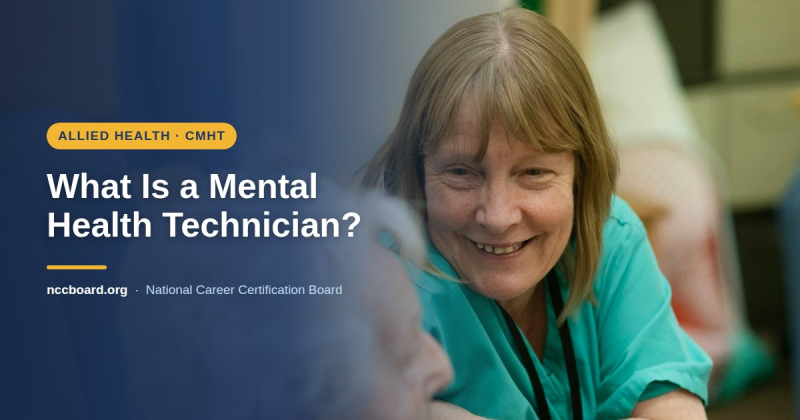
It's two in the morning on a psychiatric unit. Most patients are asleep. One isn't. He's pacing the hallway, upset and confused, and the nurse is tied up with a new admission. The person who walks over, speaks calmly, and helps him settle is very often a mental health technician.
Mental health techs don't get much attention in TV dramas. But ask anyone who works in behavioral health care, and they'll tell you the same thing. The unit doesn't run without them.
If you've been thinking about this career, here's an honest look at what the job involves, where techs work, and how to get started.
What is a mental health technician?
A mental health technician is a member of the care team who works directly with people receiving mental health or behavioral health treatment. Techs help patients with daily routines, watch for changes in behavior or mood, keep the environment safe, and report what they see to nurses, counselors, and doctors. They work under supervision and follow each patient's treatment plan.
You might also see the role called a psychiatric technician, behavioral health technician, mental health worker, or psychiatric aide. In fact, the U.S. Bureau of Labor Statistics notes that psychiatric technicians are sometimes called mental health technicians (BLS). The titles change from place to place, but the heart of the job is the same.
The eyes and ears of the treatment team
Here's a helpful way to think about the role. A psychiatrist might see a patient for fifteen or twenty minutes a day. A therapist might meet with them for an hour. The mental health tech is with them for the rest of the shift.
That makes techs the people most likely to notice the small things. A patient who stopped eating. One who seems more withdrawn after a phone call from home. One who's suddenly joking with staff for the first time in a week. Those details matter, and the tech is often the first to catch them.
Picture a pilot flying at night. They rely on their instruments to tell them what's happening outside the window. On a treatment team, the tech is one of those instruments. The clinicians make the decisions, but they're counting on good information to make the right ones.
What does a mental health technician do all day?
No two shifts look exactly alike, but most of the work falls into a few areas.
Supporting daily life
Many patients need help sticking to a routine. Techs help with meals, hygiene, sleep schedules, and getting to groups or appointments on time. For someone in crisis, a steady routine can be one of the most healing things there is.
Observing and documenting
Techs keep careful notes. They record behavior, mood, participation, sleep, and anything unusual. They also do regular safety checks, which on some units happen every fifteen minutes. Clear, accurate documentation is one of the most important parts of the job. If it isn't written down, the rest of the team can't act on it.
Helping with care and treatment plans
Techs don't design treatment plans, but they help carry them out. That might mean encouraging a patient to use a coping skill their therapist taught them. It might mean helping with an intake interview, taking vital signs, or leading a simple group activity.
Keeping everyone safe
Sometimes a patient becomes agitated or distressed. Techs are trained to notice the early warning signs and to calm the situation with words first. Staying steady when someone else is upset is a real skill, and it's one of the things good techs are known for.
Being a steady presence
This one doesn't show up on the job description, but it may be the most important part. Many patients are scared, lonely, or embarrassed to be there. A tech who treats them with respect, listens, and remembers their name can make a hard week feel a little less hard.
What mental health technicians don't do
It's just as important to understand the limits of the role. Mental health techs do not diagnose mental health conditions. They don't prescribe or change medications, and they don't provide therapy on their own. Those jobs belong to licensed professionals like psychiatrists, psychologists, counselors, and nurses.
Knowing where your role ends is part of being good at it. The best techs know when to handle something themselves and when to get a nurse or clinician right away.
Where do mental health technicians work?
More places than most people expect. Techs are part of care teams in:
- Psychiatric and mental health hospitals
- General hospitals and outpatient clinics
- Community mental health centers and social service agencies
- Residential care facilities and nursing homes
- Child and adolescent behavioral health centers
- Schools for students with developmental or learning disabilities
- Halfway houses and rehabilitation programs
Each setting has its own feel. A hospital unit can be fast-paced and unpredictable. A residential program might feel more like a home, where you build relationships with residents over months. Working with kids and teens takes a different kind of energy than working with older adults. It's worth thinking about which setting fits you best.
What skills make a great mental health tech?
You don't need to be a born therapist. But certain strengths make a big difference.
- Patience. Progress in mental health care is often slow. Some days it goes backward.
- Calm under pressure. When things get tense, people look to the steadiest person in the room.
- Good boundaries. You'll care about your patients. You also need to protect your own well-being so you can keep showing up.
- Sharp observation. Noticing small changes is a big part of the job.
- Clear writing. Your notes help guide decisions made by the whole team.
- Teamwork. You'll work closely with nurses, counselors, and doctors every shift.
- Respect for privacy. What patients share stays within the care team.
If you read that list and thought, "That sounds like me," you may be a natural fit.
How do you become a mental health technician?
Requirements vary by employer and by state. Many entry-level positions ask for a high school diploma or equivalent, along with some training or experience in health care or human services. Some employers prefer candidates with coursework in psychology or a related field.
Some states require psychiatric technicians to hold a license, which can involve finishing an accredited program and passing a state exam (BLS). California is one example. Before you apply, check the rules where you live. The U.S. Department of Labor's CareerOneStop license finder can point you to your state's requirements. It also helps to read job postings from the employers you're interested in.
A common path looks something like this:
- Get your foundation. Complete a training program, take relevant courses, or gain experience in a care setting.
- Test your knowledge. Take a practice exam to see what you know and where you need to review.
- Get certified. Earn a credential that shows employers you meet a national standard.
- Apply with confidence. Put your certification front and center on your resume.
How certification helps
Behavioral health employers are careful about who they hire. They have to be. The work is sensitive, and a new hire who isn't prepared can put patients and coworkers at risk.
The NCCB Mental Health Technician Certification (CMHT) shows that you understand how to work within a care team, support treatment plans, document accurately, and handle the real demands of direct care. It gives a hiring manager a reason to trust you before you've worked a single shift.
The CMHT exam has 80 questions and a 2-hour time limit, and you'll need a 70% or higher to pass. You take it online, from home, with secure proctoring. If you'd like to check your readiness first, NCCB practice exams pull questions from the real test bank so you know what to expect.
Is this the right career for you?
Being a mental health technician isn't easy. Some days are heavy. But many techs say it's the most meaningful work they've ever done. You get to be there for people during some of the hardest moments of their lives, and sometimes you get to watch them walk out the door stronger than they came in.
It's also a field that's growing. The Bureau of Labor Statistics projects employment of psychiatric technicians to grow 22 percent from 2025 to 2035, far faster than the 3 percent average for all jobs. The median annual wage for psychiatric technicians was $45,130 in May 2025 (BLS).
For many people, it's also a starting point. Techs often go on to careers in nursing, counseling, social work, or psychology. The experience you gain on the floor is hard to get any other way.
If this is the work you feel called to do, make sure employers know you came prepared. Learn more about the Mental Health Technician Certification (CMHT) and take your next step.
References
- U.S. Bureau of Labor Statistics. "Psychiatric Technicians and Aides." Occupational Outlook Handbook. https://www.bls.gov/ooh/healthcare/psychiatric-technicians-and-aides.htm
- O*NET OnLine. "Psychiatric Technicians (29-2053.00)." https://www.onetonline.org/link/summary/29-2053.00
- U.S. Department of Labor, CareerOneStop. "License Finder." https://www.careeronestop.org/Toolkit/Training/find-licenses.aspx
- National Career Certification Board. "Mental Health Technician Certification (CMHT)." https://nccboard.org/certification/allied-health-careers/mental-health-technician-certification-cmht